
1. A Silent Transformation Reaches Its Tipping Point
Tokenization has been evolving quietly for years — from early pilots to scattered innovation pockets, often overshadowed by crypto volatility. But 2025/26 marks the moment when tokenization moves from potential to production. Regulatory certainty, institutional commitment, scalable digital infrastructure and a global push for liquidity are converging, forming the foundations of a new financial architecture.
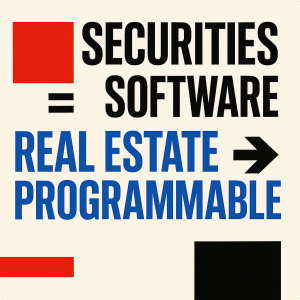
Crucially, the assets now entering this architecture are not speculative crypto instruments, but real-world assets (RWAs) — instruments with intrinsic value, well understood by institutional investors. RWAs combine familiarity with innovation: they retain the economic logic of traditional securities, but gain the programmability and global reach of digital infrastructure.
Among all categories, real estate stands out most clearly. It is vast, capital-intensive, slow-moving and constrained by local processes and fragmented registries. Tokenization directly addresses these frictions by reducing transaction costs, accelerating settlement, enabling smaller globally distributed investment tickets and opening access to liquidity for an asset class historically defined by its illiquidity — all within a regulated, institutionally acceptable framework.
In other words: the tipping point is not only technological — it is economic.
Real estate is entering a phase where digitization is no longer optional but strategically advantageous, setting the stage for the breakout moment of 2025/26.
2. From Crypto Hypes & Winters to Integrated, Regulated Capital Markets
Tokenized RWAs have grown nearly 500% since 2022 and now sit at around USD 30 billion on-chain, with projections reaching USD 15 trillion by 2030. This surge is not the result of speculative crypto cycles, but of a structural shift in how capital markets are built and governed.
Regulatory clarity itself is not new. Frameworks like MiFID in the EU and FinSA in Switzerland have long defined how securities are issued and distributed. Many expected the EU’s MiCA framework to introduce broad digital assets rules, but MiCA explicitly excludes financial instruments (incl. Securities) — these remain fully under MiFID and FinSA.
What has changed, and what now unlocks industrial-scale tokenization, are national updates to securities laws — such as Germany’s eWpG or Switzerland’s earlier adaptations through the DLT Law. These reforms allow regulated financial instruments to be issued, held and traded in purely digital form, placing security tokens onto the same legal and supervisory rails as traditional securities.
At the same time, infrastructure that once existed only in pilot environments — custody, broker-dealers, transfer agents, and DLT trading venues — has matured into an institutional-grade stack. In the U.S., developments such as the Genius Act, state-level digital-asset bills and evolving SEC interpretations show that the world’s largest capital market is moving in the same direction.
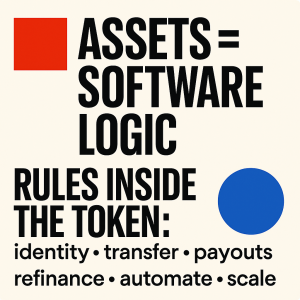
With this foundation in place, the industry has shifted decisively away from “crypto for crypto’s sake” toward digitized traditional assets, adopted by asset managers, banks and real-estate groups. Compliance-first standards like ERC-3643 embed identity and transfer rules directly into the token, allowing regulatory obligations to “travel with the token.” Globally visible lighthouse projects — such as Dubai’s 2025 attempt to model property-title transfers on-chain — underscore the direction of travel.
Even if Europe and Switzerland still focus on tokenizing economic rights rather than replacing public land registries, the broader message is unmistakable: tokenization is becoming part of regulated capital markets, not an alternative to them.
BlackRock’s Larry Fink described tokenization as “the next generation of markets” — and 2025 is the first year where this statement feels operational rather than aspirational.
3. Real Estate Moves Center Stage — And What Tokenization Really Changes
Real estate currently represents a smaller part of the tokenized market, but momentum is accelerating quickly. Fractional investment models lower entry barriers; digital issuance rails shorten funding cycles; the EU DLT Pilot and Swiss FinSA create compliant environments for secondary liquidity; and governments — most visibly Dubai — are exploring digital property records.
According to Venturebloxx, real estate is one of the top three fastest-growing RWA sectors, and the tokenized real-estate market could reach USD 1.4 trillion as early as 2026.
But its relevance becomes especially clear when examining how tokenization transforms both sides of the market:
For property owners, developers and issuers, tokenization brings flexibility and speed.
Capital can be raised without relying solely on traditional intermediaries; equity- or debt-based instruments can be issued digitally; fractional stakes placed efficiently; refinancing structured more dynamically; and international investor pools accessed at significantly lower cost.
For investors, tokenized real estate opens access where previously there was none.
Investment thresholds drop; global digital distribution becomes feasible; compliance is embedded in the transfer layer; and optional liquidity emerges via both traditional institutions and DeFi-enabled mechanisms.
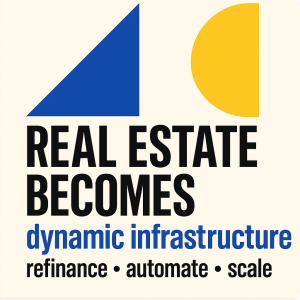
Beyond access, programmability introduces features that traditional formats cannot offer: automated distributions, multi-jurisdictional issuance, digital collateralization, fractional refinancing and real-time lifecycle management.
Real estate becomes dynamic, interoperable and financially “alive”, no longer a static and illiquid holding.
4. Switzerland: A Blueprint Jurisdiction for Industrial-Scale RWA
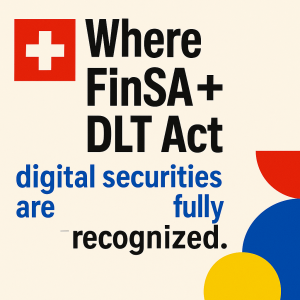
Only after understanding the global forces and the real-estate use case does the strategic role of Switzerland become fully visible. Switzerland remains one of the world’s most advanced jurisdictions for securities digitization and RWA tokenization. With FinSA and the DLT Act, it provides a clear legal foundation for digital equity and debt instruments — unlike several EU jurisdictions where tokenizing shares remains extremely difficult or impossible.
What makes Switzerland even more relevant today is that the institutional infrastructure required for industrial-scale tokenization is already in place. Regulated DLT market infrastructures such as SDX and BX Digital demonstrate how settlement and trading can operate on fully digital rails. Around them, an exceptionally mature ecosystem has developed: custodians, placement platforms, issuance and lifecycle-management providers, auditors, legal specialists and cross-border distribution partners.
Within this environment, the shift from isolated pilots to scalable, institutional-grade platforms is no longer theoretical. A compelling example is the cooperation between Brickmark X and Tokeny (Apex Group), which combines ERC-3643-based issuance, automated 24/7 investor onboarding, compliant peer-to-peer transfers and cross-platform interoperability. For issuers and investors alike, the blockchain layer increasingly disappears — tokens behave like regulated financial products, only more efficient, programmable and globally distributable.
In other words: the industrialization phase of tokenization is not emerging in Switzerland — it is already happening there.
This is also the environment in which Brickmark X, active since 2018, built one of the most robust institutional-grade real-estate tokenization platforms globally, now scaling across jurisdictions under both MiFID and FinSA standards.
Switzerland is not just participating in the global tokenization movement — it is shaping it.
5. The Road Ahead: The Industrial Phase Begins
As regulation, technology and institutional adoption now align, 2025/26 marks the beginning of the industrial phase of RWA tokenization.
Real estate — long considered conservative and slow to innovate — is emerging as one of the most transformative use cases. What is taking shape is not a new “crypto market,” but a more modern financial system, where traditional capital-market mechanisms operate on digital rails across jurisdictions.
The next chapter of global real-estate finance will be defined not by speculation, but by infrastructure, compliance and liquidity.